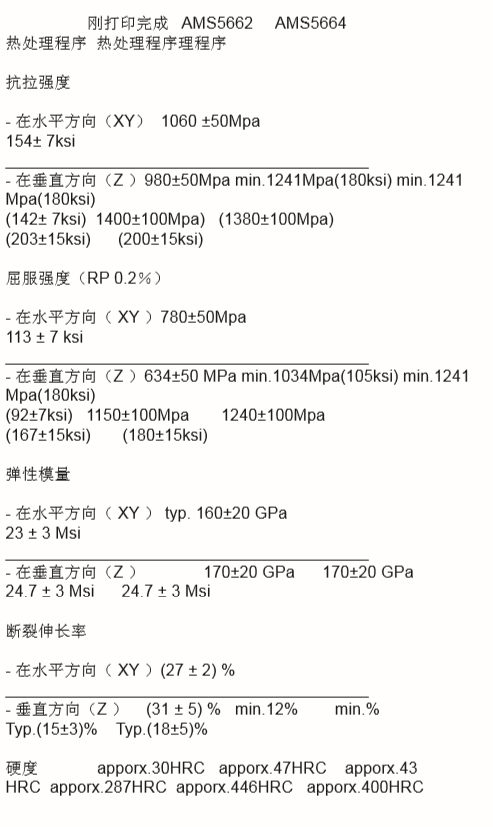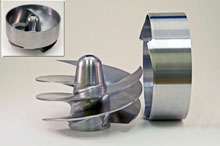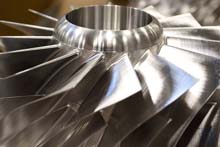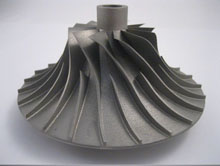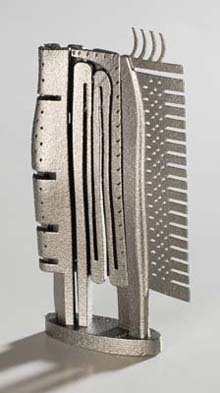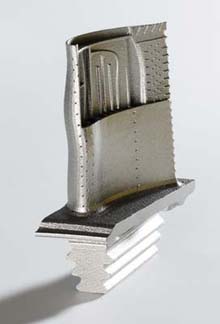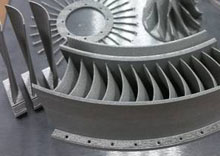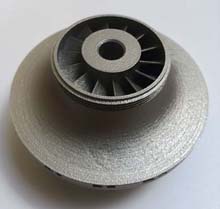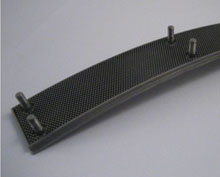

1. Maximum build size of the metal 3D printer: 250 x 250 x 325 mm;
2. 3D printing layer thickness: 0.02 mm – 0.04 mm;
3. Achievable 3D printing accuracy: typical accuracy ±0.02–0.05 mm (accuracy depends on geometry and varies with part size, build orientation, material and post-processing method);
4. Post-processing: high-temperature annealing, polishing, welding and other processing;
3D Printing Material Properties
The 3D printing metal powder nickel alloy NickelAlloy IN718 corresponds in part to the following chemical compositions: UNS N07718, AMS 5662, AMS 5664, W. Nr. 2.4668, DIN NiCr19Fe19NbMo3. This precipitation-hardened nickel-chromium alloy is characterized by good tensile, fatigue and creep properties and fracture strength at temperatures up to 700 °C (1290 °F).
This material is ideal for high-temperature applications such as aerospace, rocket and missile gas turbine engine parts, chemical, oil well, petroleum and natural gas industry components, and power and industrial fittings; it also has good potential for low-temperature applications. 3D-printed parts made from NickelAlloy IN718 can easily be hardened by precipitation-hardening heat treatment. They can be machined, EDM-eroded, welded, micro-shot-peened, polished and coated. Because they are manufactured by a layer-by-layer build method, parts exhibit a certain XYZ-axis anisotropy — see the example technical data.
Material Data
Chemical Composition
Ni (50 - 55 wt-%)
Cr (17.0 - 21.0 wt-%)
Nb (4.75 - 5.5 wt-%)
Mo (2.8 - 3.3 wt-%)
Ti (0.65 - 1.15 wt-%)
Ai(0.20 – 0.80 wt-%)
Co (≦1.0 wt-%)
Cu (≦0.3 wt-%)
C(≦0.08 wt-%)
Si, Mn (each ≦0.35 wt-%)
P, S (each ≦0.015 wt-%)
B (0.006 ≦0.006wt-%)
Fe (balance)


Material Data
Chemical Composition
Ni (50 - 55 wt-%)
Cr (17.0 - 21.0 wt-%)
Nb (4.75 - 5.5 wt-%)
Mo (2.8 - 3.3 wt-%)
Ti (0.65 - 1.15 wt-%)
Ai(0.20 – 0.80 wt-%)
Co (≦1.0 wt-%)
Cu (≦0.3 wt-%)
C(≦0.08 wt-%)
Si, Mn (each ≦0.35 wt-%)
P, S (each ≦0.015 wt-%)
B (0.006 ≦0.006wt-%)
Fe (balance)
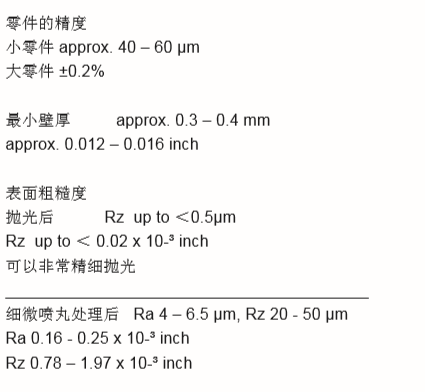
Part Mechanical Properties at 20 °C (68 °F)