Photosensitive resin is the dedicated 3D printing material for SLA rapid prototyping. SLA (stereolithography apparatus) is a 3D printing process also known as selective curing of liquid photosensitive resin, commonly shortened to stereolithography. SLA technology is based on the light-curing principle of liquid photosensitive resin: under ultraviolet light of a certain wavelength and intensity (the laser wavelength lies in the UV range, around 325 nm), the resin rapidly undergoes cross-linking and forms a cured solid.
SLA materials are generally liquid photosensitive resins, such as photosensitive epoxy resin, photosensitive vinyl ether, photosensitive epoxy acrylate and photosensitive acrylic resin. Photosensitive resin consists of two main parts: a photoinitiator and the resin itself (the resin being made up of prepolymers, diluents and a small amount of additives). When the photoinitiator is exposed to ultraviolet light of a certain wavelength (300–400 nm), it absorbs light energy, changes from the ground state to an excited state, and then generates active free radicals that trigger the polymerization and curing of prepolymers and reactive monomers. The diluent mainly serves to dilute, ensuring the photosensitive resin has sufficient fluidity at room temperature so that it levels out before the next layer is formed.
The amounts of photoinitiator and diluent have an important effect on the curing speed and curing quality of photosensitive resin. Within a certain range, increasing the photoinitiator content can moderately speed up curing; but beyond that range, adding more actually slows curing down instead of speeding it up. The diluent content strongly affects how quickly the liquid surface levels: a larger amount lowers viscosity and improves leveling, but an excessive amount makes the linear molecular chains too far apart, reducing the chance of cross-linking and inevitably affecting curing speed and quality. When the proportions of photoinitiator and diluent are appropriate, both curing speed and curing quality are good.
Photosensitive resin materials are required to have the following characteristics: rapid curing under monochromatic light of a certain frequency, with a low critical exposure and a large curing penetration depth; low curing shrinkage — shrinkage causes parts to deform, warp or crack and thus affects the accuracy of the formed part, so low-shrinkage resins help produce high-precision parts; low viscosity — low viscosity during forming helps the resin level out over the already-cured layer; low swelling — swelling of wet-formed parts in liquid resin makes part dimensions larger; and rapid prototype parts must have sufficient strength and good surface finish, with low toxicity during forming, and so on. Of course, after forming and cleaning there is no toxicity or contamination, so there is no need to worry about using it.
3D Printing Technical Specifications
1. Build size (single print): 600 x 600 x 400 mm;2. Layer thickness: 0.05 mm – 0.25 mm;
3. Achievable accuracy: forming accuracy ±0.1 mm (L ≤ 100 mm) or ±0.1% × L (L > 100 mm)
4. Post-processing: easy polishing, painting, electroplating and drilling; large parts can be assembled from sections;
Photosensitive Resin Material Properties
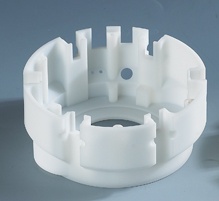
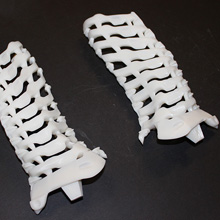
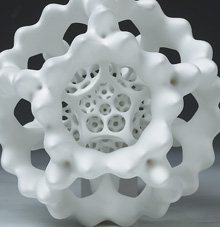
It is a durable photosensitive resin material similar to ABS, with an opaque white appearance. These printed parts can be sanded and polished, painted, coated and electroplated, and closely resemble ABS engineering plastics.
Photosensitive Resin Mechanical Properties

Thermal and Electrical Properties

The photosensitive resin properties above are commonly used material data; there are of course also high-temperature-resistant, high-hardness and highly flexible grades to choose from.